






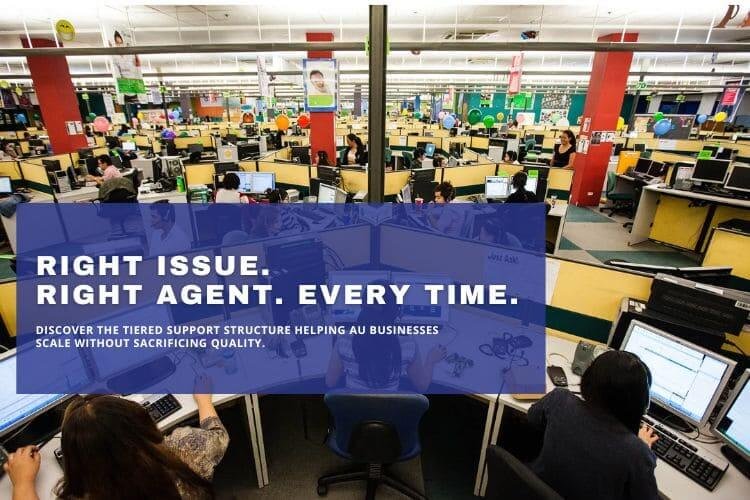
Customer support volume doesn’t grow linearly — it spikes. A product launch, a service disruption, a seasonal surge, or simple business growth can overwhelm a flat support team faster than you can hire to match it. When a single tier of agents is managing everything from password resets to complex billing disputes, response times suffer, issues fall through the cracks, and customer satisfaction drops alongside them.
What is a multi-tier customer support structure? It’s a model that distributes customer enquiries by complexity: Tier 1 agents manage high-volume, routine requests; Tier 2 manages escalations and specialist issues; Tier 3 resolves critical cases and complex problems requiring senior expertise. Each tier handles what it’s designed for — keeping the right issues with the right people and preventing your most skilled agents from spending their time on basic FAQs.
For AU businesses looking to scale without proportionally increasing costs, customer service outsourcing to the Philippines offers a practical path to building this structure. This article explains how the tiered model works, why Filipino BPO teams are well-suited to deliver it, and how to implement it in a way that improves the customer experience.
What Is a Multi-Tier Customer Support Structure?

A tiered support model distributes inbound enquiries based on complexity rather than treating every contact as equal. The result is a more efficient operation: routine requests are resolved quickly at Tier 1, more complex issues are escalated to Tier 2 specialists, and only the most critical cases reach Tier 3. Every tier operates with clear scope, defined escalation triggers, and appropriate staffing levels.
Tier 1 — Front-Line Assistance
Tier 1 agents manage the highest volume of contacts and focus on fast, consistent resolution of routine requests:
- Frequently asked questions and product information
- Password resets and account access
- Order tracking and status updates
- Basic troubleshooting using documented scripts
- Standard refund and returns processing
Tier 1 is script-driven and targets rapid resolution. First-contact resolution rates and average handle time are the primary performance metrics here.
Tier 2 — Escalation and Specialist Handling
When a Tier 1 agent reaches the limit of their authority or expertise, the issue escalates to Tier 2. These agents have deeper product knowledge and handle:
- Technical issues beyond basic troubleshooting
- Escalated complaints requiring empathy and judgement
- Account-specific concerns needing internal system access
- Workflow exceptions outside standard procedures
Tier 2 agents coordinate with internal teams — operations, logistics, billing — and require more training and experience than Tier 1 generalists.
Tier 3 — Senior Resolution Management
Tier 3 is reserved for critical cases, high-priority clients, and issues where standard processes don’t apply:
- Advanced technical troubleshooting
- Policy exceptions and high-value dispute resolution
- Senior account management for priority customers
- Operational oversight and quality escalations
Tier 3 requires decision-making authority and senior product expertise. Volume at this level should be low — if it isn’t, it signals issues at Tier 1 or Tier 2.
Why the Tiered Structure Outperforms a Flat Model
The efficiency gains from help desk outsourcing organised into tiers are significant. Routine contacts resolved at Tier 1 cost less to manage and free specialist agents for genuinely complex work. Escalation paths are structured rather than ad hoc. Customer experience improves because the right person manages each issue at the right speed. And because the model scales by tier — adding Tier 1 capacity doesn’t require adding senior agents — staffing decisions become more targeted and cost-effective.
Why Filipino BPO Teams Are Ideal for Multi-Tier Support
A Filipino BPO team can manage multi-tier customer service for AU businesses because it combines the communication skills, scalable staffing, and customer service orientation that tiered support requires — at a cost structure that makes the model sustainable for growing businesses.
The Philippines has built its international reputation in customer service for good reason. Here’s what makes it particularly effective for AU -facing multi-tier operations:
Strong English Proficiency and Communication Quality
Filipino support professionals communicate clearly, with strong comprehension and a customer-friendly manner that aligns well with AU customer expectations. The Philippines ranks among the top English-proficient countries in Asia, with accent neutrality and professional communication style that customers respond to positively across phone, email, and live chat.
Scalable Talent Pool Across All Tiers
The Philippine BPO sector employs two million professionals with experience spanning every level of customer support — from high-volume Tier 1 generalists to technically skilled Tier 2 specialists and senior Tier 3 leads. Recruiting across all three tiers from a single market simplifies management and ensures cultural consistency across the team.
Cultural Compatibility with AU Customers
Filipino professionals are familiar with Western business communication norms, customer service expectations, and the professional tone AU customers expect. The cultural adjustment period is shorter than with many other offshore markets, and agents are trained to manage difficult conversations with the empathy and professionalism that sustains customer relationships.
Cross-Industry Experience
Philippine BPO customer service teams support clients across healthcare, retail, e-commerce, logistics, finance, and SaaS — meaning there’s a talent pool with directly relevant experience for most AU business sectors.
Cost Efficiency Without Quality Compromise
The cost of building an equivalent multi-tier support structure in the AU — salaries, National Insurance, benefits, office space — is higher than customer service outsourcing to the Philippines at comparable quality levels. For remote customer support teams operating across all three tiers, the savings typically reach 50 to 70 per cent versus domestic hiring.
Time Zone Flexibility for Extended Coverage
Philippine Standard Time runs 7 to 8 hours ahead of AU time depending on the season. Afternoon shifts in the Philippines align with AU morning business hours, enabling real-time collaboration during the working day while also providing cost-effective after-hours and weekend coverage that would be expensive to maintain with AU -based staff.
How to Build Your Multi-Tier Support Structure with a Filipino BPO Team
The benefits of outsourcing customer service to the Philippines go beyond cost reduction. AU businesses gain faster scalability, structured support operations, improved coverage, and a more consistent customer experience — built on a foundation of experienced offshore professionals who are already practised in the tiered model. Here’s how to implement it:
1. Map Your Support Volume
Before defining tiers, analyse what you’re receiving. Categorise your inbound contacts by type, complexity, and frequency. Identify your peak periods, your most common enquiry types, and where your current team is spending the most time. This data drives every structural decision that follows.
2. Define Each Tier’s Scope
Set clear boundaries for what belongs at each tier — and define the escalation triggers that move a contact from one tier to the next. Ambiguous escalation rules create friction and inconsistency. Every agent should know exactly when to escalate and to whom.
3. Recruit by Tier
Tier 1 roles suit high-energy, process-oriented agents with effective communication skills. Tier 2 requires analytical ability, product depth, and composure under pressure. Tier 3 demands senior experience and decision-making authority. Recruiting to these profiles — rather than hiring generically — ensures each tier performs as designed. Working with a BPO partner experienced in tiered recruitment makes this process significantly faster.
4. Build a Knowledge Base
Your support team is only as good as its documentation. Develop scripts for Tier 1 common contacts, SOPs for Tier 2 workflows, escalation guides for each tier boundary, and troubleshooting documentation for technical issues. A well-maintained knowledge base reduces handle time, improves consistency, and accelerates onboarding for new agents.
5. Set KPIs Per Tier
Each tier has different performance priorities. Track:
- Tier 1: First-contact resolution rate, average handle time, CSAT
- Tier 2: Resolution rate, escalation frequency to Tier 3, customer satisfaction
- Tier 3: Time to resolution, case closure rate, customer retention outcomes
Performance visibility across all three tiers lets you identify bottlenecks, adjust staffing, and refine workflows before problems compound.
6. Review and Optimise Regularly
A tiered structure isn’t a set-and-forget solution. Monthly reporting — ticket volume by tier, escalation rates, KPI trends — reveals where the model is working and where it needs adjustment. Staffing levels should be reviewed as volume patterns shift, and documentation should be updated as your product or service evolves.
Expert insight: High escalation rates from Tier 1 to Tier 2 usually signal a documentation or training gap — not a staffing shortfall. Address the root cause before adding headcount.
Build Your Support Team with CreaThink Solutions
CreaThink Solutions helps AU businesses build structured, scalable customer service operations through BPO customer service outsourcing from the Philippines. Whether you’re implementing a multi-tier model from scratch or strengthening an existing support function, CreaThink Solutions provides the staffing expertise, operational infrastructure, and management support to make it work.
Customer service and technical support capabilities include:
- Tier 1 front-line customer service (phone, email, live chat)
- Tier 2 escalation handling and specialist support
- Tier 3 senior resolution management and technical support
- Omnichannel support coordination
- Help desk operations and ticketing system management
- Customer success coordination
Full-service operational support: CreaThink Solutions manages recruitment, onboarding, training, HR administration, workforce management, and compliance — so your team is fully operational without requiring you to build the supporting infrastructure yourself. See how CreaThink Solutions customer service outsourcing model works.
Two flexible engagement models:
- BPO / Managed Teams — Ideal for AU businesses that want fully managed, scalable customer service operations with CreaThink Solutions overseeing day-to-day performance and workforce management.
- Employer of Record (EOR) — Ideal for businesses that want to hire dedicated support staff and manage them directly, with CreaThink handling payroll, HR, and Philippine employment compliance.
Both models deliver experienced Filipino support professionals, structured tiered operations, and significantly lower operating costs than equivalent AU-based hiring. Contact CreaThink Solutions to discuss your support structure and staffing requirements.
Build a support structure that scales with your business. Talk to CreaThink Solutions today.