







Australian businesses are generating more operational and customer data than ever — and how that data gets captured, processed, and stored has a direct impact on efficiency, accuracy, and compliance. Choosing the wrong method doesn’t just slow operations down; it creates gaps in data quality, security exposure, and scalability that are difficult to fix after the fact.
What is the difference between online and offline data entry? Online data entry involves entering data directly into cloud-based systems, web platforms, CRMs, or live databases — with real-time synchronisation and remote access. Offline data entry uses local software, spreadsheets, or standalone systems that don’t require a live internet connection, with data transferred or uploaded separately when needed.
Both methods are legitimate and widely used. The right choice depends on your workflows, security requirements, team structure, and growth plans. For many Australian businesses, the smartest approach is also knowing when outsourced data entry services can handle the workload more efficiently than internal staff — regardless of which method you’re using.
What Is Online Data Entry?
Online data entry means your data goes directly into a connected system — a CRM, e-commerce platform, web-based database, or cloud application — in real time. It’s also one of the fastest-growing sources of online data entry jobs in Australia, as businesses increasingly hire remote specialists to manage live systems and cloud-based records.
Common Use Cases
- CRM updates and customer record management
- E-commerce order processing and inventory tracking
- Online form submissions and registrations
- Remote collaboration platforms and shared databases
- Customer support ticket systems
Benefits
Real-time synchronisation means your data is current the moment it’s entered. Remote teams can access and update records simultaneously without version conflicts. Scaling is straightforward — add users, expand permissions, and your data infrastructure grows with the business.
Risks to Manage
Online systems introduce cybersecurity exposure. Every access point is a potential vulnerability, which means strong encryption, multi-factor authentication, and tight access controls are non-negotiable. Businesses operating under the Australian Privacy Act 1988 must ensure cloud-based systems meet the privacy and data handling obligations that apply to personal information — and cloud providers need to be vetted accordingly.
Data entry outsourcing for online systems works well when your provider has experience with your specific platforms and follows documented access security protocols.
What Is Offline Data Entry?
Offline data entry captures information into local files, spreadsheets, desktop software, or standalone databases that operate without live internet connectivity. Data is typically processed in batches and uploaded or transferred to a central system once complete.
Common Use Cases
- Spreadsheet management and bulk data processing
- Scanned document digitisation and archiving
- Confidential internal records and HR files
- Batch data entry from physical forms or paper records
- Legacy system maintenance
Benefits
The primary advantage is reduced internet exposure. Data being processed in a controlled local environment faces fewer cybersecurity risks than data flowing through cloud systems. For highly sensitive or regulated data, offline processing can offer tighter environmental controls.
Limitations
The trade-off is accessibility and collaboration speed. Offline files are location-dependent until they’re transferred, which creates delays for distributed teams. Version control becomes a manual process. And without real-time synchronisation, there’s always a gap between when data is captured and when it’s usable across the business.
For Australian businesses managing data entry services in-house or choosing to outsource data entry to the Philippines, offline workflows are manageable — but they require clear transfer processes and quality checks to prevent data loss or duplication during the handover step.
Online vs. Offline Data Entry: Key Differences for Australian Businesses
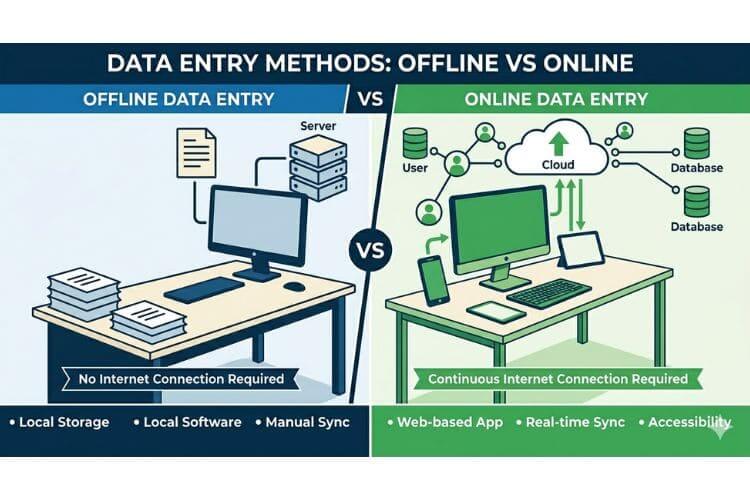
The best data entry method for Australian businesses depends on the nature of the data, security and compliance requirements, remote access needs, and scalability goals. Online systems suit real-time collaboration and distributed teams. Offline systems are better suited to controlled, sensitive, or batch-processing environments.
Here’s how the two approaches compare across the factors that matter most:
| Factor | Online Data Entry | Offline Data Entry |
| Speed | Real-time updates and immediate sync | Requires upload or transfer steps |
| Security | Needs strong encryption and access controls | Lower internet exposure and attack surface |
| Accessibility | Accessible to remote teams instantly | Dependent on local access |
| Cost | Subscription and platform fees apply | Lower software costs; less infrastructure |
| Scalability | Easier to scale with remote teams | Less flexible for distributed operations |
| Compliance | Must meet Privacy Act and cloud security standards | Must meet Privacy Act; controlled environment may simplify governance |
Compliance Considerations
Regardless of which method your business uses, both online and offline data entry must comply with the Australian Privacy Act, your industry’s data governance obligations, and any applicable state or sector-specific requirements. According to the Office of the Australian Information Commissioner (OAIC), businesses are responsible for the security of personal data they collect — including data processed by third-party providers. This means any outsourced data entry arrangement requires documented data handling agreements.
Expert insight: Choosing between online and offline isn’t a permanent decision. Many businesses use both — online for live operational data, offline for archival or sensitive batch processing. The key is having the right safeguards in place for each environment
Why Outsourcing Data Entry Makes Sense for Australian Businesses
Should Australian businesses outsource their data entry? For most, yes — particularly when data volumes are growing, internal teams are stretched, and the cost of local hiring makes dedicated data entry staff difficult to justify. The most effective data entry services Australia businesses rely on combine accuracy, speed, and scalability at a fraction of the cost of managing it in-house.
Reduced Internal Workload
Data entry is time-consuming and detail intensive. When internal staff handle it alongside their primary responsibilities, both suffer. Outsourcing frees your team to focus on higher-value work while a dedicated offshore team manages the data processing backlog.
Lower Operational Costs
Hiring a full-time data entry specialist in Australia carries significant overhead — salary, superannuation, leave entitlements, and equipment. Outsourcing data entry to the Philippines delivers the same dedicated expertise at substantially lower cost, with flexible engagement models that scale to your actual workload.
Improved Accuracy
Dedicated data entry professionals working within standardised workflows make fewer errors than overloaded internal staff juggling multiple responsibilities. Quality control processes — including double-keying and reconciliation checks — further reduce error rates.
Scalability on Demand
Workability spikes — end of financial year, product launches, compliance audits — create demand that’s hard to staff for permanently. Outsourced teams scale up and down quickly, giving you capacity when you need it without permanent headcount overhead.
Support Across Both Online and Offline Environments
Experienced outsourcing providers handle both. Whether your data lives in a CRM, an Excel spreadsheet, a scanned PDF, or a legacy database, a skilled virtual assistant data entry team can process it accurately and return it in whatever format your systems require.
Faster Turnaround
Dedicated offshore teams — often working across Australian business hours with overlapping shift coverage — process data faster than internal staff who fit it around other work. Turnaround times improve, and operational bottlenecks clear.
Outsource Your Data Entry with CreaThink Solutions
CreaThink Solutions helps Australian businesses reduce administrative overhead and improve data accuracy through reliable, scalable outsourced data entry services delivered by pre-vetted Filipino professionals.
Whether your data entry needs are online, offline, or a combination of both, CreaThink Solutions provides the structured operational support to handle it efficiently — without the cost or complexity of expanding your local headcount.
Administrative and data support services include:
- CRM data entry and record management
- Spreadsheet processing and data cleaning
- Document digitisation and archival
- Database updates and maintenance
- Online form processing and data capture
- Records management and compliance documentation
Staff quality: CreaThink Solutions’ team members are detail-oriented offshore professionals experienced across leading CRM platforms, spreadsheet tools, document management systems, and database administration — with structured onboarding tailored to your specific systems and workflows. See how CreaThink’s virtual assistant services work.
Two flexible engagement models:
- BPO / Managed Teams — Best for ongoing administrative operations where CreaThink Solutions provides managed offshore teams with built-in quality oversight and scalable staffing.
- Employer of Record (EOR) — Best for businesses that want to hire dedicated remote staff directly and manage their day-to-day work, with CreaThink Solutions handling payroll, compliance, and HR administration.
Both models deliver accurate data processing, reliable turnaround times, and significantly lower operational costs than equivalent Australian hiring — giving growing businesses the data support they need without the overhead they can’t sustain. Contact CreaThink Solutions to discuss your data entry requirements.
Stop letting data entry slow your business down. Talk to CreaThink Solutions and outsource smarter today.