





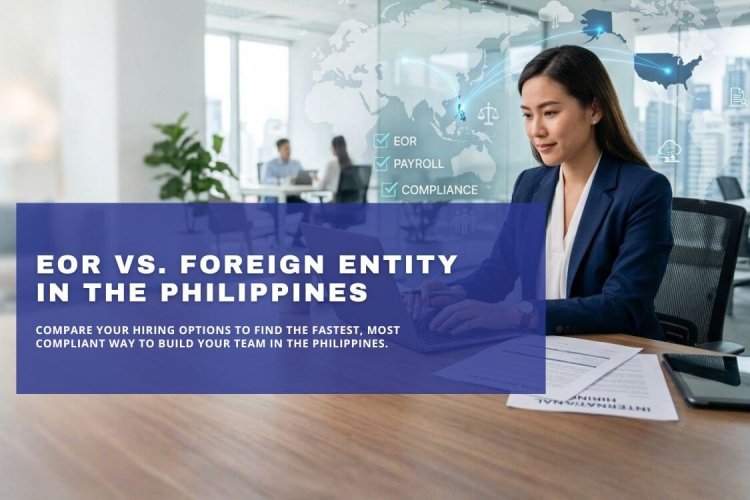
Hiring in the Philippines has become an increasingly common move for US companies looking to build out customer support, back-office, and technical teams, drawn by a large English-speaking workforce and meaningful cost savings compared to domestic hiring. But once a business decides to move forward, a practical question comes up almost immediately: should you use an employer of record in the Philippines, or register your own legal entity in the country?
Both paths let you legally employ Filipino talent. They differ enormously in cost, speed, and administrative burden. This article walks through how each option works, compares them side by side, and helps you decide which approach fits your hiring goals.
What Is an Employer of Record (EOR)?
An Employer of Record, or EOR, is a third-party organization that legally employs workers on your behalf in a country where your business has no registered entity. The EOR handles local payroll, statutory benefits, tax withholding, and employment contracts, while you continue directing the employee’s day-to-day work.
For companies exploring EOR in the Philippines specifically, this structure removes the need to incorporate locally before hiring. Here’s what an EOR typically manages on the employer’s behalf:
- Drafting compliant local employment contracts
- Running payroll and remitting mandatory contributions (SSS, PhilHealth, Pag-IBIG)
- Withholding and filing employee income tax
- Administering statutory benefits like 13th month pay and leave entitlements
- Acting as the legal employer of record for labor disputes and government filings
Because the EOR already has the legal infrastructure in place, a US company can typically have a new hire onboarded within days rather than months. That speed, combined with lower upfront cost, is a major reason EOR arrangements have become a popular way to test the Philippine market before committing to a permanent legal presence.
What Does Setting Up a Foreign Entity Involve?
If you’d rather set up a company outright, establishing a foreign entity in the Philippines means registering your own legal business presence, typically as a subsidiary, branch office, or representative office, through the Securities and Exchange Commission (SEC). Each structure carries different tax treatment and liability implications, so most companies work with local legal counsel before choosing one.
Registering an entity generally involves:
- Reserving a company name with the SEC
- Filing incorporation documents and securing a certificate of registration
- Registering with the Bureau of Internal Revenue (BIR) for tax purposes
- Enrolling with SSS, PhilHealth, and Pag-IBIG as an employer
- Obtaining local business permits from the relevant city or municipality
This process commonly takes two to four months and involves legal, accounting, and government filing fees that can run into the tens of thousands of dollars once ongoing compliance is factored in. After incorporation, the entity still needs local accounting, tax filings, and HR administration on a continuing basis, which is why many businesses only pursue this route once headcount justifies the investment.
EOR vs. Foreign Entity: Side-by-Side Comparison
For most US companies just starting to hire in the Philippines, an EOR is the faster and lower-risk option, while a foreign entity makes more sense once the team is large and permanent enough to justify the setup cost. The table below breaks down how the two compare.
| Factor | Employer of Record | Foreign Entity |
| Setup time | Days to a couple of weeks | Roughly 2–4 months |
| Upfront cost | Low, service-fee based | High (legal, registration, ongoing compliance) |
| Legal liability | Held by the EOR | Held directly by your company |
| Compliance management | Handled by the EOR | Managed in-house or via local advisors |
| Best suited for | Testing the market, small or distributed teams | Large, long-term teams with dedicated local operations |
How Can US Companies Legally Hire in the Philippines?

US companies can legally hire in the Philippines by either partnering with an EOR or registering their own local entity; independent contractor arrangements are only appropriate for genuinely independent work and carry real misclassification risk if the relationship functions like employment. Beyond choosing a structure, employers need to understand a handful of local rules before extending an offer.
- Option 1: Partner with an EOR. This is the quickest legal path to hiring, since the EOR already holds the registrations and licenses required to employ staff compliantly.
- Option 2: Establish a local legal entity. This route makes sense when a company is confident it will maintain a substantial, long-term presence in the Philippines and wants full operational control.
A few Philippine labor law basics that US employers should keep in mind, regardless of which structure they choose:
- The Department of Labor and Employment (DOLE) sets minimum employment standards, including required benefits and termination rules that differ meaningfully from US at-will employment norms.
- Employee classification matters. Treating someone as an independent contractor when they work fixed hours, use company equipment, and report to a manager can expose a business to backpay and penalty risk.
- 13th month pay is a legally mandated benefit, not a discretionary bonus, and must be budgeted accordingly.
The most common compliance risk US employers run into is misclassification, either treating employees as contractors to avoid payroll obligations, or assuming US-style at-will termination applies. Both can create legal exposure that outweighs any short-term savings.
When EOR Makes More Sense for Your Business
An EOR arrangement tends to be the better fit when:
- You’re testing the Philippine market before committing to a permanent setup
- You need to hire quickly and can’t wait months for entity registration
- You want to minimize the administrative burden of local payroll and compliance
- You’re building a small or distributed team rather than a large local office
A US healthcare practice hiring a single medical billing virtual assistant, for example, has little reason to open a Philippine subsidiary. An EOR lets that practice hire compliantly within days and scale the arrangement only if the role proves out. The calculus shifts for a company planning to build a 200-person delivery center, where the long-term savings of owning the entity outweigh the setup cost.
Hire in the Philippines the Smarter Way with CreaThink Solutions
Deciding between an EOR and a foreign entity ultimately comes down to timeline, budget, and how committed your business is to a long-term Philippine presence. For most companies dipping a toe in, or scaling a lean remote team, employers of record services offer the fastest, lowest-risk way to get started.
CreaThink Solutions supports US employers expanding into the Philippines with compliant, well-managed staffing solutions built around how growing teams operate. Whether you need help with our EOR solution, broader Business Process Outsourcing services, or guidance on which approach fits your situation, our team of outsourcing specialists can walk you through the options honestly, including when a foreign entity is the better long-term move.
Ready to hire in the Philippines without the hassle of navigating it alone? Get in touch with the Creathink Solutions team for a consultation or browse our blog for more insights on building a compliant, cost-effective offshore team.
Stay updated with the latest insights by following us on Facebook, LinkedIn, and YouTube