






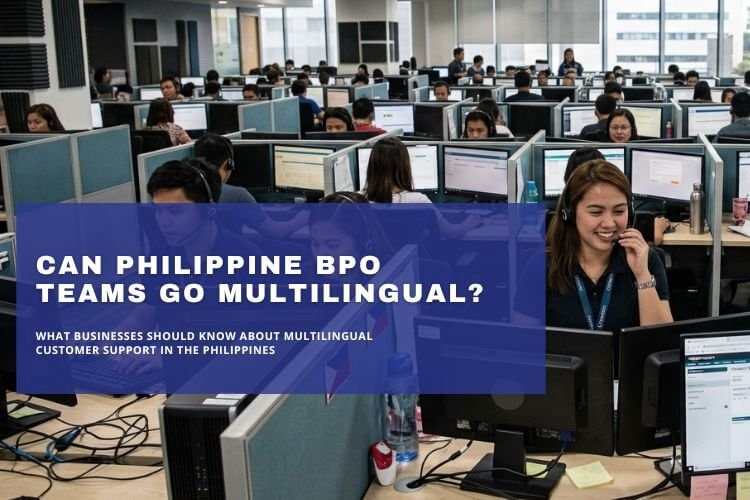
The Philippines is well known for its English-language customer service capabilities. Its established BPO industry, English-speaking workforce, and experience supporting international businesses have made outsourced customer service in the Philippines a popular option for companies looking to expand their support capacity.
But as businesses enter new markets, their global customer support requirements often become more complex. Instead of supporting customers only in English, they may need assistance in languages such as Mandarin, Japanese, Korean, Spanish, or other languages relevant to their markets.
So, can Philippine BPO teams provide multilingual customer support?
Yes, but capability varies by provider, language, required proficiency, service channel, and staffing model.
A multilingual contact center in the Philippines can help businesses serve customers across different languages and communication channels. However, businesses should not assume that a provider with strong English-language capabilities can offer the same depth of support in every language.
This guide explains what to expect from multilingual BPO support in the Philippines and what Australian businesses should consider before choosing a provider.
Why the Philippines Is Known for English-Language Customer Support
English is widely used in education, business, and professional environments in the Philippines, contributing to a substantial workforce capable of supporting international customers.
The country’s established BPO sector has also developed extensive experience serving English-speaking markets. Over time, this has contributed to recruitment practices, training programs, quality assurance (QA) processes, and management structures designed around international customer service.
For Australian businesses, outsourced customer service in the Philippines can support functions such as:
- Phone support
- Live chat
- Email support
- Customer enquiries
- Technical and product support
- Order and account assistance
Multilingual customer support, however, introduces additional recruitment, training, and QA considerations.
Can Philippine BPO Teams Support Languages Beyond English?

Yes. Multilingual talent is available in the Philippines, but availability can vary considerably between languages and providers.
Some BPO providers may already have bilingual or multilingual professionals within their workforce or recruitment networks. Others may need to recruit specifically for a client’s requirements.
The difficulty of filling a multilingual role can depend on:
- The language required
- Required spoken and written proficiency
- Whether native-level or professional working proficiency is needed
- Customer service or technical experience
- Phone, chat, or email requirements
- Working hours and time-zone coverage
- Team size
- Industry knowledge
For Australian businesses evaluating multilingual customer support in the Philippines, these requirements should be discussed early. A provider should be able to explain whether suitable talent is already available or whether targeted recruitment will be required.
Which Languages Can Philippine BPO Teams Support?
There is no universal list of languages that every Philippine BPO provider can support.
Depending on the provider’s workforce and recruitment capabilities, businesses may be able to source professionals with proficiency in languages such as:
- Mandarin
- Japanese
- Korean
- Spanish
- French
- German
- Vietnamese
- Other regional or international languages
Availability should always be confirmed directly with the provider.
More importantly, businesses should define the level and type of language proficiency required.
An employee who can confidently handle written enquiries, for example, may not necessarily have the conversational fluency required for complex phone support. Similarly, general language proficiency does not automatically mean an agent understands technical terminology or industry-specific language.
Language requirements should therefore be assessed alongside customer service skills and role-specific expertise.
What Does a Multilingual Contact Centre Provide?
A multilingual contact centre can support global customer support operations across several communication channels, depending on the provider’s capabilities and available language talent.
- Phone support generally requires strong conversational proficiency because agents need to understand and respond to customers in real time.
- Live chat and messaging require written fluency, accuracy, comprehension, and the ability to respond quickly while maintaining the appropriate tone.
- Email support can be suitable for less time-sensitive enquiries, but businesses still need QA processes to ensure responses are accurate, natural, and consistent with the brand.
- Technical or product support requires both language ability and product knowledge. Agents need to understand the issue and explain solutions clearly in the customer’s preferred language.
The more specialised the role, the more important it becomes to evaluate both language proficiency and job-specific expertise.
Outsourced Multilingual Support vs Hiring In-House
For Australian businesses expanding into multilingual markets, one decision is whether to recruit language specialists internally or work with an outsourcing provider.
Neither approach is automatically better.
An outsourcing provider may offer established recruitment channels and experience sourcing customer service professionals. Depending on the language and provider, outsourcing can also offer greater flexibility when additional capacity is required.
In-house teams, meanwhile, provide more direct management oversight and may develop deeper familiarity with the business and target market over time.
Some businesses may benefit from a hybrid model. Internal staff can retain customer service leadership and complex escalations, while an outsourced team provides additional language coverage, after-hours support, or capacity during periods of higher demand.
The right model depends on customer volume, budget, management requirements, available talent, and how strategically important the target market is to the business.
What to Ask Before Outsourcing Multilingual Customer Support
Not every provider with strong English-language support services will have the same capabilities in other languages. Before committing to a multilingual BPO provider, ask:
1. Do you already have talent available in the language we need?
Determine whether suitable professionals are already available or whether a new recruitment process is required.
2. How do you assess language proficiency?
Ask whether candidates undergo spoken and written assessments appropriate to the role.
3. Can you assess both language skills and role-specific knowledge?
Multilingual agents may also need experience in areas such as technical support, e-commerce, finance, software, or another specialised field.
4. What level of proficiency can you recruit for?
Define whether you need native-level fluency, professional working proficiency, conversational ability, or written proficiency.
5. What is the realistic recruitment timeline?
Ask for an estimate based on the specific language, proficiency level, team size, and experience requirements.
6. How is multilingual quality monitored?
Determine who reviews customer interactions and whether QA reviewers can properly assess the language being used.
7. How are agents trained on our products and brand?
Language proficiency alone is not enough. Agents also need product knowledge and an understanding of your customer service standards.
8. Can the team scale if demand increases?
Ask about staffing availability, expected lead times, and any contractual requirements associated with changing team size.
A provider should be able to answer these questions specifically rather than relying on broad assurances about multilingual capabilities.
How CreaThink Solutions Approaches Outsourced Customer Service
At CreaThink Solutions, we take a tailored approach to outsourced staffing. We begin by understanding each client’s required roles, workload, customer service channels, operating hours, and skill requirements before determining the appropriate team structure.
Our Customer Service and BPO solutions include recruitment, training, ongoing communication, and quality assurance based on the requirements of the engagement.
Where a business requires specific language capabilities, those requirements should be identified from the beginning so candidate availability, proficiency expectations, recruitment needs, and service delivery requirements can be assessed before the team is built.
For businesses that prefer more direct oversight of offshore staff, our Employer of Record (EOR) solution provides an alternative staffing model in which CreaThink Solutions acts as the legal employer and manages employment-related functions such as payroll, statutory contributions, employment contracts, and HR administration in the Philippines.
Is Multilingual Customer Support in the Philippines Right for Your Business?
Philippine BPO teams can support businesses building a multilingual contact centre or broader global customer support operation, but success depends on careful planning, realistic staffing expectations, and proper quality controls.
Rather than simply asking whether a provider can find someone who speaks a particular language, consider whether it can source professionals with the right combination of:
- Language proficiency
- Customer service experience
- Channel-specific communication skills
- Product or industry knowledge
- Working-hour availability
- Appropriate QA support
For some roles, suitable talent may already be available. Others may require a more targeted recruitment process.
Setting clear expectations from the beginning helps both your business and the outsourcing provider determine what is realistically achievable.
If you’re already exploring outsourced customer service in the Philippines, read our guide to customer service KPI tracking for outsourced teams for more information on measuring performance once your team is in place.
Businesses operating in sectors with specific staffing pressures may also find our article on NDIS workforce challenges and staff shortages useful when evaluating offshore support options.
Explore Outsourced Customer Service with CreaThink Solutions
If your business is considering multilingual or outsourced customer service in the Philippines, get in touch with CreaThink Solutions to discuss your requirements.
You can also explore our Solutions to learn more about our BPO and EOR services or browse the CreaThink Solutions blog for more insights on building and managing outsourced teams in the Philippines.
Stay updated with the latest insights by following us on Facebook, LinkedIn, and YouTube.