






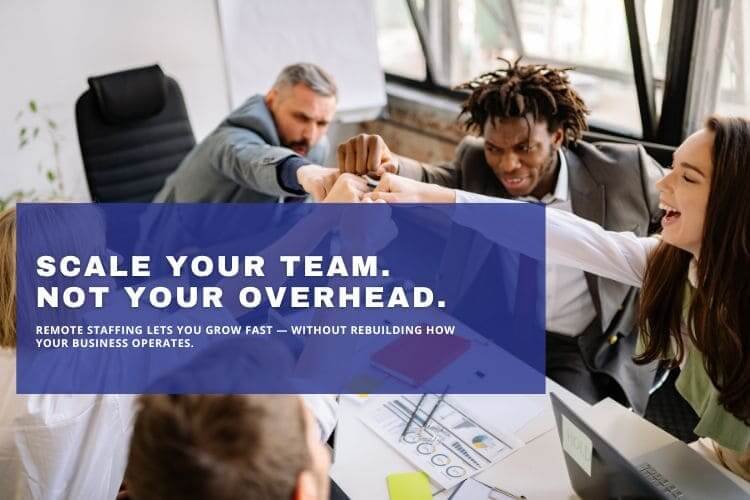
Hiring locally is getting harder. Costs are rising, good candidates are scarce, and the time it takes to fill a single role can stall entire growth plans. More businesses — from startups to mid-market firms — are turning to remote staffing solutions to expand capacity without the overhead that comes with traditional hiring.
Do you need to completely change your business operations to use remote staffing solutions? No. Most companies integrate remote staff gradually, using the tools, and workflows they already have. The goal isn’t to rebuild how you operate — it’s to add capacity in a way that supports what’s already working.
This article walks through how hiring remote staff works in practice: how to integrate it without friction, what you need to get started, and how to avoid the mistakes that slow most companies down.
Why Businesses Are Scaling with Remote Staffing Solutions
Remote staffing has moved from a workaround to a mainstream growth strategy — and for good reason. The operational and financial case is strong.
Faster Access to Talent
Traditional hiring often takes weeks or even months. Remote and offshore staffing solutions can shorten that process by giving businesses access to pre-vetted candidates who are ready to start. When opportunities arise or key team members leave unexpectedly, hiring quickly becomes critical.
Lower Operational Costs

Remote staff don’t require office space, equipment procurement at full cost, or the same benefits overhead as local hires. For many businesses, switching even a portion of their workforce to a remote workforce solution cuts operational expenses by 40 to 60 percent without touching service quality.
Improved Scalability
Seasonal demand, project surges, and rapid expansion are much easier to manage with a distributed team. You can scale up or down without the hiring freezes and severance costs that make traditional workforce planning so rigid.
Business Continuity and Flexibility
A distributed team is also a more resilient one. When local disruptions affect one location — whether a weather event, infrastructure failure, or staffing crisis — offshore teams continue operating. That geographic redundancy is increasingly valuable in an unpredictable operating environment.
How Hard Is It to Integrate Remote Staff into an Existing Team?
Integrating remote staff into an existing team is straightforward when communication and onboarding are treated as priorities from day one. The challenge isn’t location — it’s clarity. Remote staff perform best when expectations, tools, and workflows are well-documented, not when they’re expected to figure things out independently.
Start with Clearly Defined Roles
Before boarding anyone remotely, document what the role actually requires: daily responsibilities, KPIs, reporting lines, and communication expectations. Vague job descriptions create confusion for local hires too — the difference is that remote staff have fewer informal ways to fill in the gaps.
Use Your Existing Tools
You almost certainly don’t need new software. Slack, Microsoft Teams, Zoom, Asana, Trello, Google Workspace, and similar platforms already support distributed work natively. Remote staff can be added to existing channels and project boards with minimal setup. Businesses rarely need to rebuild operations from scratch — they need to apply existing systems more deliberately.
Create Structured Onboarding
The first two to four weeks determine whether a remote hire succeeds. Build a structured onboarding process that includes written SOPs, recorded or live training sessions, shadowing opportunities with existing team members, and scheduled check-ins with a direct manager. Document everything. Good onboarding materials also improve consistency for your entire team — remote and local.
Prioritize Communication and Culture
Regular check-ins, clear feedback loops, and team rituals (even virtual ones) keep remote staff connected to the broader team. A weekly team standup, monthly one-on-ones, and an open communication channel go a long way toward preventing the isolation that derails remote work arrangements.
Operational example: A U.S.-based logistics company added three remote administrative coordinators to support their dispatch team. Using their existing CRM and communication tools, the new hires were contributing independently within three weeks. The integration required no new software — just documented SOPs and a structured two-week onboarding plan.
What Do You Need to Get Started with Remote Staffing?
You need less than most people expect. The most common barrier to starting is the assumption that remote staffing requires a major operational overhaul. It doesn’t. Here’s what matters:
1. Identify Roles Suitable for Remote Work
Start with functions that are already process-driven and measurable. Strong candidates include:
- Customer support and live chat
- Administrative and data entry support
- Bookkeeping and accounts payable
- Marketing coordination and content support
- IT helpdesk and technical support
- Sales operations and CRM management
2. Define What You’re Trying to Achieve
Cost reduction, faster scaling, extended coverage hours, and operational efficiency all require slightly different staffing approaches. Clarity on your primary goal helps you choose the right roles, the right volume, and the right engagement model.
3. Establish Basic Systems
You need: a communication platform, a task or project management tool, a secure file-sharing environment, and a way to track performance. If you already have these in place for your local team, you’re ready. If not, setting them up benefits everyone — not just remote staff.
4. Choose the Right Staffing Partner
Not all remote staffing providers deliver the same quality. Evaluate partners on recruitment standards, onboarding support, compliance handling, scalability, and communication transparency. A provider who handles the operational complexity of hiring remote employees lets you focus on managing the work, not the paperwork.
| What You Need | What You Don’t Need |
| Defined roles and KPIs | New software or tech stack |
| Basic communication tools | A dedicated remote work policy from day one |
| Structured onboarding process | A separate management team |
| A reliable staffing partner | To overhaul existing workflows |
| Clear performance metrics | To hire large teams immediately |
Common Mistakes Companies Make When Scaling Remote Teams
Most remote staffing failures trace back to the same avoidable errors:
Hiring too quickly without clear processes. Bringing on remote staff before roles are well-defined leads to unclear accountability. Define expectations before you recruit, not after.
Treating remote staff as second-tier. Excluding remote workers from team meetings, decisions, or communication channels creates a two-tier culture that damages retention and performance. Remote staff should be integrated — not isolated.
Skipping documentation. Without written SOPs and workflows, remote staff default to their own judgment, which creates inconsistency. Document processes for your whole team, not just new remote hires.
Ignoring security and compliance. Remote work introduces data access and security considerations that need to be addressed deliberately. Define access controls, data handling policies, and compliance requirements from the start — particularly in regulated industries.
Choosing cost over quality. The cheapest option rarely delivers the best outcome. Providers who cut corners on recruitment or onboarding create short-term savings and long-term problems. Evaluate total operational value, not just the hourly rate.
How Remote Staffing Supports Long-Term Business Growth
Beyond immediate cost savings, remote staffing becomes a structural advantage as companies scale. Distributed teams make it easier to enter new markets, extend service hours across time zones, and access specialized skills that aren’t available locally.
A company expanding from the U.S. into international markets, for example, can use remote staff to provide regional customer support before committing to a physical presence. A growing healthcare practice can hire a remote billing specialist without recruiting locally in a tight labor market. A logistics firm can extend dispatch coverage to overnight hours using a distributed team — without overtime costs.
According to McKinsey & Company, remote work has accelerated across industries and is now embedded in workforce planning at the strategic level. Companies that build remote staffing competency now will have a measurable hiring and operational advantage as competition for local talent continues to intensify.
Scale Smarter with CreaThink Solutions
CreaThink Solutions helps U.S. businesses scale efficiently through remote staffing and outsourcing — without the operational disruption that companies fear.
Whether you need one dedicated hire or a fully managed team, CreaThink Solutions handles the complexity: recruitment, onboarding, workforce management, and compliance — so your team stays focused on running the business.
Service areas include:
- Administrative and back-office support
- Customer support and contact center operations
- Technical support and IT helpdesk
- Sales operations and lead management
- Finance and accounting support
- Healthcare and real estate support
Engagement models:
- Remote Staffing — Dedicated remote staff integrated into your existing team and workflows
- BPO Services — Fully managed outsourcing teams with operational oversight handled by CreaThink Solutions
- Employer of Record (EOR) — Hire specific individuals directly while CreaThink Solutions manages payroll, HR, and local compliance
Explore CreaThink’s staffing solutions and see how businesses across industries are building scalable, resilient teams from the Philippines.
Ready to scale your business without overloading your operations? Partner with CreaThink Solutions and build a reliable remote team designed for growth.